In households without running water, bathing could require collecting water from a well, pump, river, or another available source.
Someone then had to transport it into the home, often using buckets or other containers.
If warm water was desired, it had to be heated, commonly over a fire or stove.
Only after those preparations could a bath begin.
Depending on the household and period, people might bathe in portable tubs, wash using bowls and basins, or rely on other arrangements appropriate to their circumstances.
The process could require considerable effort, especially when large quantities of water were involved.
Afterward, the used water also needed to be emptied and disposed of.
A modern bathtub may seem like a simple household fixture, but the convenience we associate with it depends on an extensive infrastructure of water supply and drainage.
The same was true, in a different way, of toilets.
Before flushing systems became widely accessible, many households used chamber pots, outdoor privies, or other forms of sanitation.
A chamber pot could be kept inside a bedroom or another private area and emptied later.
An outdoor privy, sometimes called an outhouse, provided a separate location away from the main living spaces.
These arrangements varied considerably according to geography, economic circumstances, climate, and local customs.
Not every household had a dedicated bathing room, and the development of bathrooms did not follow one universal pattern.
Nevertheless, the central difference from modern life remains clear.
Using water and managing human waste once required far more manual work.
Indoor plumbing promised to change that.
But the transition would take time, experimentation, and major improvements in engineering.
How the Water Closet Became an Important Innovation
The concept of using water to carry waste away is much older than the modern flush toilet.
Various ancient civilizations developed sophisticated drainage systems, channels, and sanitation facilities.
However, the household flushing toilet familiar today emerged through centuries of experimentation and improvement.
Early devices existed long before they became practical or affordable for widespread use.
One important challenge involved controlling water.
A flushing toilet requires a reliable supply of water and a mechanism capable of directing it through the bowl.
It also needs a way to remove waste and prevent unpleasant sewer gases from entering the room.
Without suitable drainage and ventilation, simply introducing water into a toilet could create new problems rather than solve existing ones.
Over time, inventors and engineers developed better valves, traps, pipes, cisterns, and ceramic fixtures.
These improvements helped transform flushing toilets from specialized installations into practical components of modern buildings.
During the eighteenth and nineteenth centuries, the water closet became increasingly associated with sanitation technology.
It represented a new way of managing human waste through a water-based flushing mechanism.
The distinction mattered because other types of toilets did not necessarily use water in the same way.
An earth closet, for example, used dry materials rather than a conventional water-flushing system.
The name water closet therefore identified a particular technological arrangement, not merely an unusually small room.
The word water referred to the flushing process.
The word closet reflected an older meaning connected with a private or enclosed room.
Together, the words described a private toilet facility equipped with a water-based system.
That combination was both practical and descriptive.
And as the technology developed, the terminology became increasingly familiar.
Why Was It Called a “Closet” in the First Place?
For modern Americans especially, the word closet usually brings one image to mind.
A storage space.
Perhaps it is a bedroom wardrobe filled with clothing, a narrow cupboard containing cleaning supplies, or a small room where unused household items are kept.
So the expression water closet can sound a little strange.
Why would anyone describe a toilet using a word associated with storage?
The answer lies in the history of language.
The English word closet did not originally refer exclusively to a place for keeping clothes or belongings.
Historically, it could describe a small private room or enclosed space.
Such rooms might be used for personal activities, quiet reflection, study, or other purposes requiring privacy.
The word developed from older French forms associated with enclosure.
In fact, the idea of a small, enclosed private space existed in English long before the modern walk-in wardrobe became a familiar household feature.
The Online Etymology Dictionary traces the history of closet to the late fourteenth century, when it could refer to a private room.
Etymology, Origin & Meaning
Seen through that historical lens, the phrase water closet begins to sound much more logical.
It did not necessarily mean that someone removed their coats from a cupboard and replaced them with a toilet.
Instead, it referred to an enclosed private space equipped with a water-flushing convenience.
Some early toilets were indeed installed in compact rooms or adapted spaces.
Others were incorporated into buildings through different architectural arrangements.
The idea that all early water closets began as converted storage cupboards is therefore an oversimplification.
But the connection between privacy, enclosure, and sanitation helps explain why the name made sense.
Language often preserves meanings that become less obvious over time.
The word closet continued to evolve, eventually becoming strongly associated with storage in everyday American English.
Meanwhile, water closet retained its older association with a small private toilet space.
The resulting phrase survived even as the meanings of its individual words changed.
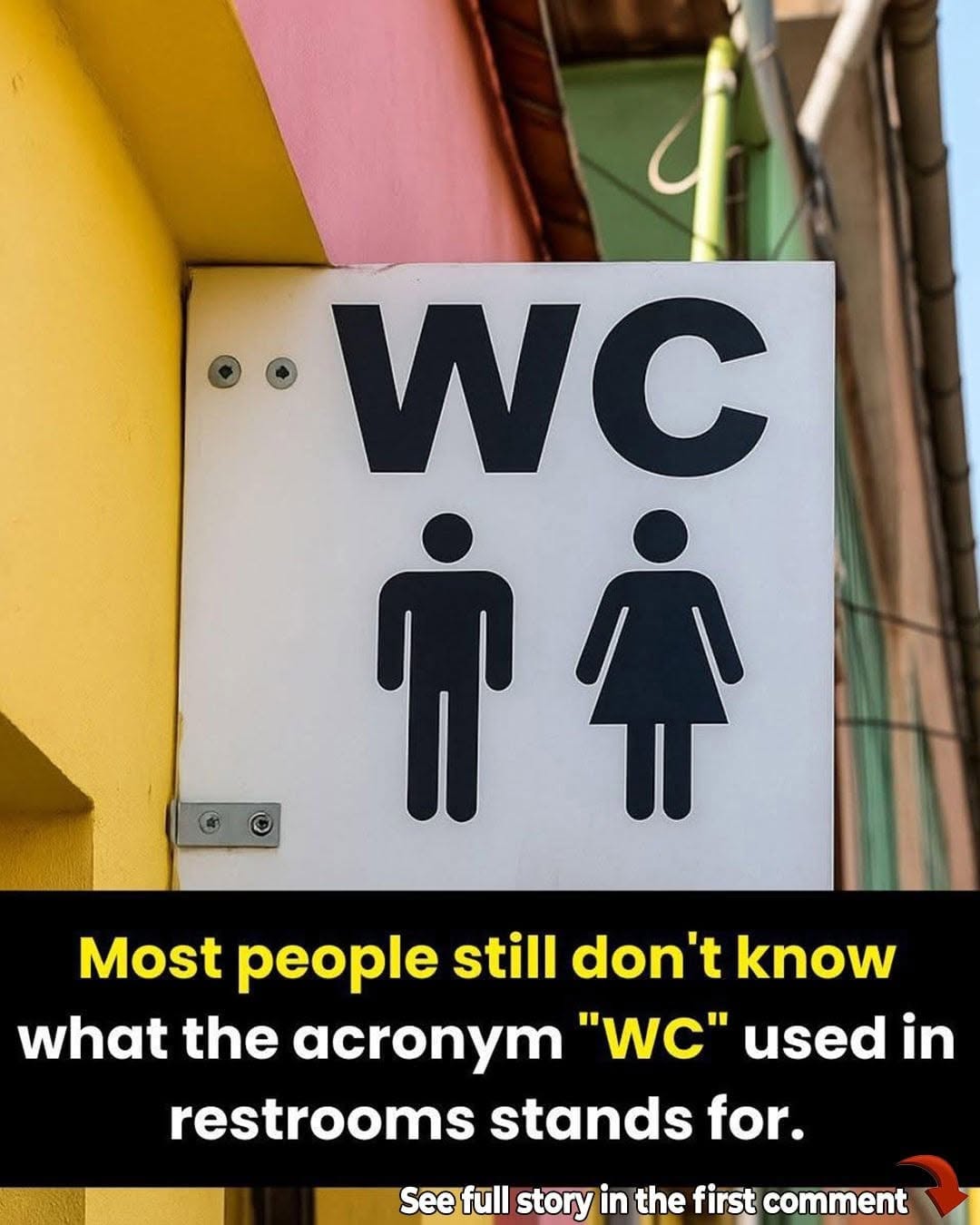
That is one of the reasons WC can seem so mysterious to modern readers.
The letters preserve a vocabulary shaped by an earlier world.
The Nineteenth Century Changed the Bathroom Forever
Although water closets existed before the nineteenth century, that period was especially important for the development of modern plumbing.
As cities expanded and industrialization accelerated, the need for more reliable water distribution and waste removal became increasingly pressing.
Growing urban populations created enormous sanitation challenges.
Crowded housing, inadequate drainage, contaminated water, and poorly managed waste could contribute to serious public health problems.
Municipal authorities, engineers, physicians, and reformers increasingly recognized that improving sanitation was essential to making cities healthier and more livable.
The response involved far more than inventing a better toilet.
Cities needed water mains, sewers, pumping systems, drainage networks, and increasingly organized approaches to public hygiene.
Buildings also needed internal pipes and fixtures capable of connecting to these expanding systems.