Water closets were not always created by converting ordinary storage cupboards.
Furthermore, the term predates the widespread adoption of indoor plumbing in the nineteenth century.
Its historical roots are documented in the eighteenth century, and its abbreviated form was already in use by the early nineteenth century.
These details do not make the social media explanation worthless.
Instead, they reveal how a short, appealing explanation can open the door to a much richer history.
The creator answered the central question correctly.
The additional historical context simply makes the answer more complete.
And the result is arguably even more interesting than the simplified version.
Those letters connect not just to the shape of a small room, but to centuries of changes in technology, public sanitation, language, and domestic architecture.
Why the WC Sign Has Never Completely Disappeared
With all the modern alternatives available, it might seem surprising that WC remains in use.
Restroom signs can simply say toilet.
They can display pictograms.
They can use local-language labels or a combination of symbols and words.
Why retain an abbreviation that many people cannot explain?
One reason is familiarity.
In locations where WC has appeared for generations, people recognize it through experience.
Its practical meaning does not depend on understanding its origin.
Another reason is brevity.
Two letters fit neatly onto small signs, doors, and architectural plans.
The abbreviation is also flexible.
It can appear on its own or alongside other symbols, including arrows and accessibility signage.
In multilingual settings, a familiar short label may be convenient, although WC is not universally understood.
Historical continuity also plays a role.
Buildings often retain traditional terminology long after everyday speech has changed.
An older railway station, hotel, or public facility may preserve signage styles that reflect its history.
Even newer buildings may continue using those familiar conventions.
The result is a curious mixture of old and new.
A sign developed from historical English terminology can guide visitors toward a restroom containing modern water-saving fixtures, automatic taps, and advanced ventilation.
The surrounding technology may be entirely contemporary.
The label is not.
That contrast is part of what makes WC interesting.
It has survived because it remains useful.
Its original words are less important to its everyday function than the meaning people have learned to associate with the abbreviation.
A Tiny Discovery That Changes the Way We Notice Everyday Things
For many viewers, learning the meaning of WC will not change their lives in any significant way.
They will still enter the same restrooms.
They will still follow the same signs.
And the next time they need a toilet in a busy train station, they probably will not spend much time reflecting on eighteenth-century sanitation terminology.
But they may notice those letters differently.
Instead of seeing an unexplained sign, they will recognize the shortened form of water closet.
Perhaps they will remember how people once relied on chamber pots, outdoor privies, and manually carried water.
Maybe they will think about how indoor plumbing gradually transformed the design of homes.
Or they might simply smile at the realization that they have finally solved a mystery they never knew they cared about.
Small discoveries like this can be surprisingly satisfying.
They remind us that familiarity is not the same as understanding.
We can encounter something thousands of times and still know almost nothing about its origin.
A street name may preserve the memory of a vanished landmark.
An everyday phrase may come from an occupation that no longer exists.
A household object may retain a design created for a purpose that has since disappeared.
And a restroom sign can preserve terminology from a time when flushing toilets were an emerging technological convenience rather than a routine part of domestic life.
The world is full of such details.
Most of them go unnoticed until someone asks a question.
The Real Meaning Behind Two Ordinary Letters
Ultimately, the mystery of WC has a wonderfully straightforward answer.
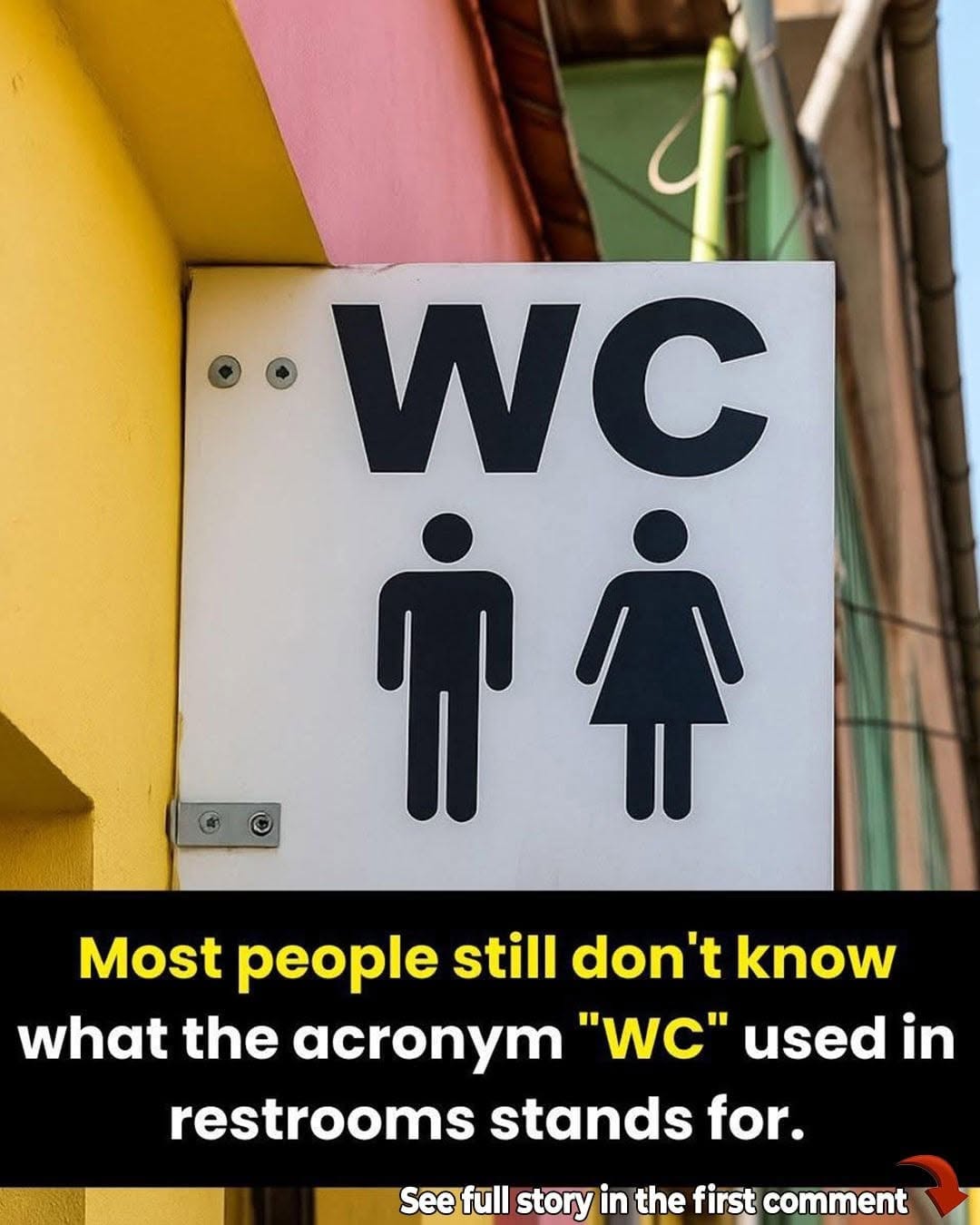
W stands for Water. C stands for Closet.
The expression originally described a water-flushing toilet or a private space containing one.
Its roots reach back to the eighteenth century, and its abbreviated form was documented in the early nineteenth century.
As plumbing technology developed and sanitation facilities became increasingly common, the abbreviation continued to appear in buildings and public spaces.
It eventually spread beyond English-speaking environments, becoming familiar in several countries and languages.
Today, WC remains a recognizable restroom label even though many people rarely use the full phrase water closet in ordinary conversation.
The TikTok discussion surrounding the abbreviation demonstrated how a simple question can reveal a surprising gap in everyday knowledge.
Some viewers had known the meaning for years.
Others were discovering it for the first time.
And many found amusement in realizing that two letters they had seen throughout their lives carried a history they had never considered.
Perhaps that is the most memorable part of the story.
The meaning was never truly hidden.
It was preserved in dictionaries, building terminology, and the history of plumbing.
Yet for countless people, the letters remained unexplained because there had never been a reason to ask.
Until someone finally did.
So the next time you find yourself walking through a railway station, exploring an unfamiliar European city, or searching for a restroom in a restaurant, take a moment to notice the signs around you.
If you see those two familiar letters, you will know exactly what they stand for.
But you will also know something more.
Behind that simple WC sign lies a story of changing homes, evolving language, engineering innovation, and the gradual transformation of an essential part of everyday life.
Two letters. Two words. And a surprisingly long history hiding in plain sight.
Sources and Further Reading
The historical and linguistic details in this expanded article are supported by the following references:
Oxford Learner's Dictionaries — Water Closet: Definition of water closet and its abbreviation.
Online Etymology Dictionary — Water Closet: History of the expression and its early recorded use.
Online Etymology Dictionary — W.C.: Historical documentation of the abbreviation.
Oxford Learner's Dictionaries — Toilet: Differences between British and North American usage.
JOE — People Are Only Just Learning What WC Means: Reporting on the TikTok explanation and public reactions.