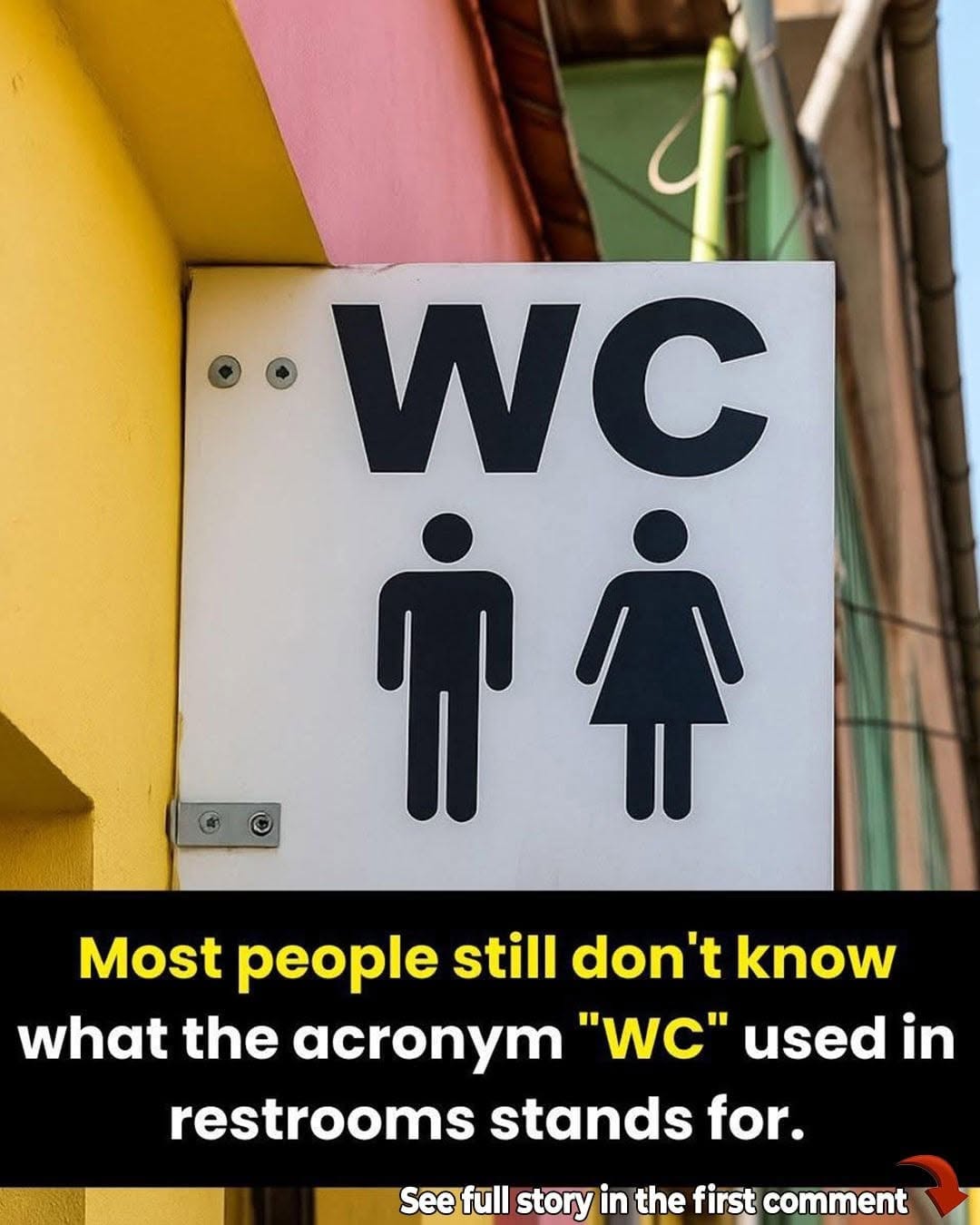
Chapter 1
People Are Only Now Discovering What “WC” Really Stands For on Bathroom Signs — And the Surprising History Behind Those Two Letters
The familiar two-letter sign has been hiding a fascinating piece of history in plain sight for generations.

You have probably seen those two letters countless times throughout your life.
Perhaps they were printed on a door at a train station, displayed above a public restroom in a shopping center, or attached to the wall of a restaurant somewhere in Europe. Maybe you spotted them while traveling abroad, searching desperately for the nearest bathroom.
The letters were simple, familiar, and impossible to mistake for anything other than a sign pointing toward a toilet.
WC.
But have you ever stopped to wonder what those two letters actually mean?
For many people, the answer is surprisingly unclear.
Although the abbreviation appears on restroom signs in numerous countries, not everyone knows where it originated or why it remains so widely used today. Some people recognize it immediately without understanding the words behind it. Others have spent decades walking past WC signs without once questioning their meaning.
And when the answer finally comes, it often produces the same reaction: surprise, amusement, and a sudden realization that something ordinary has been hiding an unexpected history.
That is exactly what happened when a TikTok creator decided to answer a question that many people had apparently been wondering about for years.
What began as a simple explanation of a restroom sign quickly turned into a conversation about language, plumbing, architecture, and the fascinating ways everyday expressions survive long after the world around them has changed.
The answer, as it turns out, takes us back centuries, to a time when indoor plumbing was far from an ordinary household convenience.
And the story behind WC is much more interesting than those two letters might suggest.
A Simple Bathroom Sign That Has Confused People for Years
Across the world, people use many different words to describe the place they visit when nature calls.
In the United States, someone might politely ask where the restroom is. At home, the same person might refer to the bathroom, even when the room contains no bathtub.
In Canada, the term washroom is particularly common.
In the United Kingdom, people generally understand the words toilet, lavatory, and loo. The phrase public conveniences also survives on some signs, although it can sound rather old-fashioned.
Elsewhere, expressions vary according to local languages, customs, and regional preferences.
Despite these differences, everyone is ultimately referring to the same essential facility.
Yet WC occupies an unusual position among these terms.
Unlike bathroom, restroom, or toilet, it offers no obvious clue to its meaning for someone unfamiliar with the abbreviation.
The letter W might suggest water, but the C could stand for almost anything.
For someone encountering it for the first time, the sign can look more like an unexplained code than a recognizable English expression.
Nevertheless, it has become a familiar feature of public spaces, particularly in parts of Europe.
Travelers may encounter WC signs at railway stations, airports, hotels, museums, cafes, restaurants, and older public buildings.
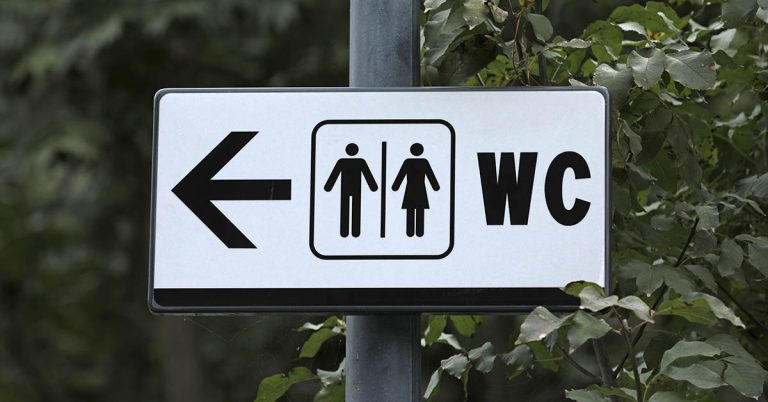
The abbreviation often appears alongside familiar restroom symbols, making its practical meaning clear even when its original words remain a mystery.
And that is precisely why so many people have never bothered to investigate it.
When a sign successfully tells you where to go, there is little reason to question its history.
You simply follow the arrow, open the door, and continue with your day.
But curiosity has a way of turning even the most ordinary objects into unexpected discoveries.
Sometimes, all it takes is someone asking a question out loud.
The TikTok Video That Finally Answered the Question
The mystery attracted renewed attention when TikTok content creator @itsnathannyc responded to a follower who wanted to know what WC actually stood for.
It was a straightforward question, but one that apparently resonated with many viewers.
Reports about the video described it as having received more than 3,500 views at the time, along with comments from people who admitted they had never understood the abbreviation.
The creator explained that WC stands for Water Closet.
That is the entire answer.
Two familiar words, shortened into two letters that have survived for generations.
But the explanation did not stop there.
The TikToker connected the expression to the history of indoor plumbing, explaining that homes once relied on arrangements very different from the bathrooms we know today.
According to his simplified account, people historically had bathing areas where water had to be carried in and heated manually.
When modern indoor plumbing gradually transformed domestic life, toilets needed suitable locations inside buildings.
Small private rooms were one practical option, and those spaces became associated with the term water closet.
The explanation gave viewers a vivid picture of why the phrase made sense.
Suddenly, those mysterious letters were no longer mysterious at all.
They referred to a private space containing a toilet that used water to remove waste.
The historical development was more complicated than this brief social media explanation suggests, but its central point was correct.
WC is indeed an abbreviation of water closet.
Historical dictionaries confirm that the expression dates back to the eighteenth century, long before the widespread installation of modern domestic plumbing.
According to the Online Etymology Dictionary, water closet was recorded by 1755, while the abbreviation W.C. was documented by 1815.
Etymology, Origin & Meaning+1
That means the phrase and its shortened form have considerably deeper roots than many people realize.
What might appear to be a modern international symbol actually preserves a term from an earlier period of sanitation history.
And understanding why it developed requires imagining daily life before modern bathrooms became standard.
Before Indoor Plumbing, Bathrooms Were Very Different
Today, most people in homes with modern plumbing expect water to be available whenever they turn on a tap.
They can fill a bathtub, take a shower, wash their hands, or flush a toilet without giving much thought to the systems making those conveniences possible.
Clean water enters the building through pipes, while wastewater disappears into a separate drainage system.
These processes usually happen quietly and automatically.
But for much of human history, managing water was a demanding daily responsibility.