A Routine That Raised Questions
For years, Margaret and her husband Robert shared a life built on trust, companionship, and routine. So when Robert suddenly began waking up every morning at exactly 4 a.m. and locking himself in the bathroom, Margaret couldn’t help but notice.
At first, she dismissed it as a harmless habit. Everyone develops small routines as they grow older. But as the weeks passed, the behavior continued without explanation. Robert would quietly leave their bedroom before dawn, disappear into the bathroom, lock the door behind him, and remain there for nearly an hour.
Whenever Margaret asked what he was doing, he offered vague answers.
“Just taking care of a few things,” he would say.
His reluctance to explain only deepened her concerns. She wondered whether he was hiding a medical problem, struggling with something emotionally, or keeping a secret he wasn’t ready to share.
As the mystery continued, Margaret found herself becoming increasingly anxious. The man she had shared decades of life with suddenly seemed distant, and she feared something serious was happening.
The Discovery That Broke Her Heart
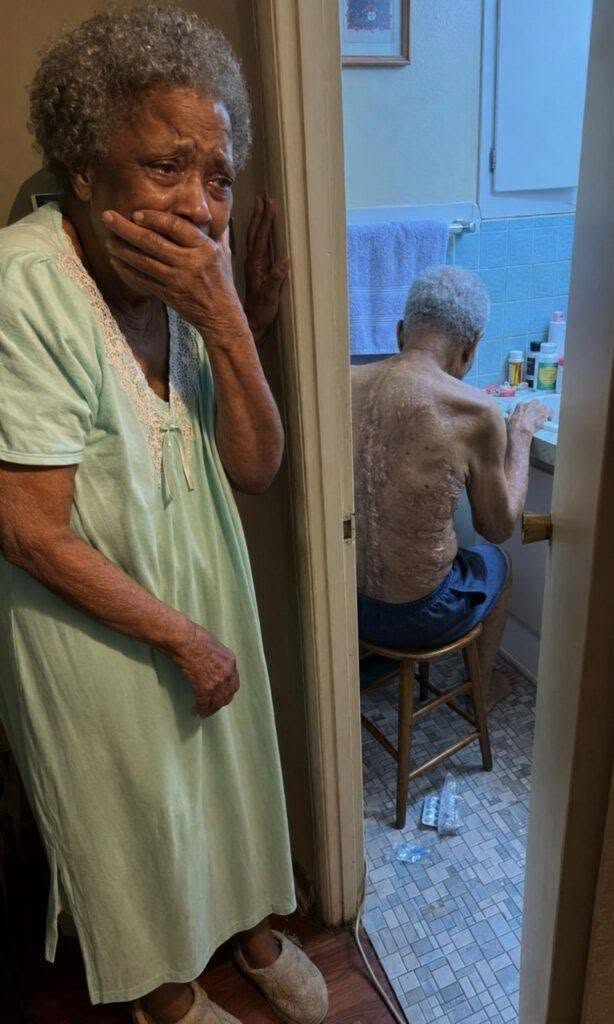
One morning, unable to ignore her worries any longer, Margaret quietly approached the bathroom door. She expected to uncover something shocking.
Instead, she discovered something heartbreaking.
Inside sat Robert, alone in front of the mirror. The once-strong man she had known for decades appeared fragile and exhausted. Age and illness had gradually changed his body, leaving him struggling with tasks that had once seemed effortless.
Rather than allowing Margaret to witness his daily struggles, Robert had chosen to face them privately.
Each morning, he woke before dawn to complete his personal care routine while preserving the dignity he felt he was slowly losing. He didn’t want his wife to see how difficult ordinary activities had become. He wanted her memories of him to remain tied to the confident, capable husband she had always known.
Margaret was overwhelmed with emotion.
For weeks she had feared betrayal or secrecy. The truth was something entirely different: love mixed with pride, vulnerability, and a desire to protect the person he cared about most.
As she watched him struggle in silence, she realized how much pain he had been carrying alone.
6
A Lesson About Love, Aging, and Compassion
That morning changed everything between them.
Instead of allowing Robert to continue facing his challenges alone, Margaret sat beside him and listened. For the first time, he openly spoke about his fears, his declining strength, and the frustration of no longer being able to do everything independently.
The conversation brought tears to both of their eyes, but it also brought relief.
Many people associate love with grand gestures, romantic surprises, and major milestones. Yet some of the deepest expressions of love emerge during life’s most difficult moments—when two people choose to remain by each other’s side despite uncertainty, illness, and change.
Aging often brings challenges that are rarely discussed openly. Pride, fear, and the desire to protect loved ones can lead people to hide their struggles, even from those closest to them.
Margaret and Robert’s experience serves as a powerful reminder that communication matters. Sometimes the secrets we fear most are not acts of deception but silent attempts to shield others from pain.
In the end, Margaret did not discover a betrayal. She discovered the vulnerability of a man who loved her deeply and wanted to preserve her peace of mind.
And Robert learned something equally important: true love does not require perfection, strength, or independence. It simply requires trust, honesty, and the courage to let someone share the weight of life’s burdens.
Together, they faced the future not as individuals carrying separate fears, but as partners once again—stronger because they finally allowed each other to see the truth.
For nearly forty years, Margaret had believed she knew everything there was to know about her husband.
She knew how he took his coffee, how he folded his shirts, and how he always checked the front door twice before going to bed. She knew the particular sound of his footsteps on the stairs, the way he hummed old songs while working in the garage, and how he pretended not to notice when she slipped an extra piece of pie onto his plate.
She knew the small things that made Robert who he was.
Or at least, she thought she did.
Then, one ordinary Tuesday morning, she woke at 4:07 a.m. and discovered that the man sleeping beside her was gone.
At first, she assumed he had gone downstairs for a glass of water. But when she heard the bathroom door close at the end of the hallway, followed by the unmistakable click of the lock, she glanced at the clock and frowned.
It was too early.
Robert had always been an early riser, but never this early. And certainly not with the bathroom door locked.
She lay still, listening to the faint sound of running water.
Ten minutes passed.
Then twenty.
At 4:45, the water stopped.
Yet Robert did not come out.
Margaret sat up in bed, her eyes fixed on the narrow strip of light beneath the bathroom door.
By the time he finally emerged, nearly an hour after he had gone inside, she had already begun inventing explanations she did not want to believe.
He looked startled when he saw her standing in the hallway.
“Margaret? What are you doing awake?”
“I could ask you the same thing.”
He gave a tired smile and reached for her shoulder.
“Couldn’t sleep. Thought I’d take a shower.”
She glanced at his dry hair.
“You took a shower?”
“Just washed up a little.”
He kissed her forehead, stepped around her, and returned to the bedroom.
The conversation lasted less than a minute.
But something about it stayed with her long after sunrise.
It was not simply that Robert had woken early. It was the locked door, the unexplained hour, and the way he had looked at her as though she had caught him doing something wrong.
For the first time in decades, Margaret wondered whether there was a part of her husband she had never truly known.
And over the next several weeks, that question would quietly change their marriage.
The Little Things That Began to Feel Like Lies
At first, Margaret tried to ignore the strange new routine.
Perhaps Robert was having trouble sleeping. Perhaps his back hurt, or his old knees were bothering him again. He was seventy-one, after all, and neither of them could pretend that their bodies were as dependable as they had been twenty years earlier.
But then it happened again.
And again.
Every morning, sometime between four and half past four, Robert would slip out of bed, walk down the hallway, and lock himself inside the bathroom.
Sometimes she heard the faucet running.
Sometimes she heard the cabinet doors opening and closing.
Once, she thought she heard something fall, followed by a sharp, frustrated whisper.
Whenever she asked about it, Robert offered another explanation.
“Just cleaning up.”
“Couldn’t get comfortable.”
“Needed a little time to myself.”
The answers were harmless enough. Yet they were always delivered too quickly, as though he had prepared them in advance.
Margaret began noticing other changes.
Robert had stopped changing clothes in front of her. He used to toss his pajamas onto the chair and pull on a clean shirt without a second thought. Now he carried his clothes into the bathroom and came out fully dressed.
He had become unusually protective of the small toiletry bag he kept beside his shaving supplies.
And when she offered to help him organize the bathroom cabinet, he reacted with a sharpness she had rarely heard from him.
“Please don’t move my things.”
The words were not cruel. But they were so unlike him that Margaret stood motionless, a folded towel in her hands.
Robert noticed her expression.
“I’m sorry,” he said immediately. “I didn’t mean to snap.”
“It’s all right.”
He reached for the towel, kissed her cheek, and changed the subject.
But Margaret could not stop thinking about it.
They had raised two children together. They had survived job losses, family illnesses, financial worries, and the painful death of Robert’s younger brother. She had sat beside him through sleepless nights in hospital waiting rooms and held his hand when he received frightening medical news.
They had built a life around honesty.
So why was he suddenly hiding something as ordinary as his morning routine?
Her imagination began filling the silence.
Was he taking medication he had not told her about? Was he struggling with an illness? Had a doctor warned him about something serious?
Or was there another possibility—one she hated herself for considering?
Was Robert having an affair?
The thought felt absurd. Robert was not the sort of man who disappeared for secret meetings or came home smelling of unfamiliar perfume. He had never been particularly interested in social media, and the only password he regularly forgot was the one for their television.
Still, people could surprise one another after forty years.
Perhaps, she thought miserably, she had become so comfortable with the man she married that she had stopped seeing the man he had become.
That night, Margaret lay awake beside him, staring at the ceiling.
Robert slept with one hand resting on the blanket between them.
She wanted to reach for it.
Instead, she turned toward the wall and waited for morning.
The Marriage They Had Built Over Forty Years
The following Saturday, Margaret found herself looking through an old photograph album.
She had been searching for a picture of their daughter, Emily, when she came across a photograph taken on their twenty-fifth wedding anniversary.
Robert stood beside her in a navy suit, his hair still mostly dark, his arm wrapped around her waist. Margaret remembered that evening clearly. They had celebrated at a small restaurant near the river, where Robert had insisted on ordering dessert even though they were both too full to eat it.
“You only turn twenty-five years married once,” he had told her.
She had laughed. “If you keep talking like that, you’ll have to take me out again for our fiftieth.”
“Deal.”
They had kept that promise.
Their fiftieth anniversary had been quieter. Robert had developed arthritis in his hands, and Margaret’s eyesight had begun to weaken. They celebrated at home with their children and grandchildren, a homemade cake, and a bottle of wine they had been saving for a special occasion.
Robert had held her hand beneath the table throughout dinner.
Later, when the guests had gone, he had looked around their familiar kitchen and said, “You know what I remember most about our marriage?”
“What?”
“All the ordinary days.”
She had smiled. “Not the wedding? Not the holidays?”
“Those were nice. But I remember you bringing me coffee when I worked late. You sitting beside me when my father was sick. The way you always knew when I was worried, even when I didn’t say anything.”
He had paused, looking down at their joined hands.
“You made life feel manageable, Margaret.”
She had leaned against him.
“And you made me feel safe.”
They had not needed grand declarations. Their love had always lived in small acts of care: a repaired button, a warm meal, a hand resting on a shoulder.
That was why the locked bathroom door frightened her.
It seemed to stand between them, a small physical barrier that had somehow grown larger than the hallway itself.
She closed the photograph album and placed it back on the shelf.
Then she made a decision.
She would stop guessing.
She would ask Robert directly, and she would give him the chance to tell her the truth.
But she would have to choose her moment carefully.
She knew her husband well enough to understand that a direct confrontation could make him retreat further into silence.
Robert had always been proud of being dependable. He was the person who carried heavy bags, fixed broken appliances, drove long distances, and insisted that everyone else sit down while he finished the work.
He was generous with his time but uncomfortable receiving help.
When he was younger, he had once driven through a snowstorm to repair his sister’s heating system, only to dismiss his own exhaustion afterward.
“It’s nothing,” he had said.
Margaret had learned that those two words often meant the opposite.
Now, as she thought about the man who had become increasingly private behind a locked door, she wondered whether he was saying “It’s nothing” again because he did not know how to say, “I’m afraid.”
The Morning She Heard Him Cry
The truth began to reveal itself on a rainy Thursday.
Margaret woke at 4:12 a.m. and reached across the bed.
Robert’s side was empty.
She sat up, pulled on her dressing gown, and stepped into the hallway.
The bathroom door was locked, as usual.
At first, she heard only the quiet hum of the ventilation fan.
Then came a sound she had never expected to hear from her husband.
A small, broken sob.
It was quickly followed by the sound of water running.
Margaret froze.
For a moment, she could not move. She had heard Robert cry before, of course. When his mother died, he had wept openly in the hospital chapel. When their son nearly lost his life in a car accident, Robert had gripped her hand and cried into her shoulder.
But those tears had been shared.
This was different.
He was crying alone, behind a locked door, in the early hours of the morning, when he believed no one could hear him.
Margaret stepped closer.
“Robert?”
The water continued to run.
“Robert, sweetheart? Are you all right?”
There was a long silence.
Then his voice came through the door, strained and unfamiliar.
“I’m fine, Margaret. Go back to bed.”
She closed her eyes.
For years, she had respected his need for privacy. She had believed that loving someone meant trusting them to tell you when they needed help.
But standing in the dim hallway, listening to the man she loved struggle alone, she understood that there was a difference between respecting privacy and allowing fear to build a wall between two people.
“No,” she said gently. “I’m not going back to bed until I know you’re safe.”
“Please.”
The single word was so quiet that she almost missed it.
Please.
Not an order. Not an excuse.
A plea.
Margaret pressed her palm against the cool wooden door.
“I’m not angry with you,” she said. “I’m not here to judge you. I just want to know what’s happening.”
For several seconds, nothing changed.
Then she heard a small click.
The lock turned.
When the door opened, Robert stood before her in his dressing gown, his face pale, his eyes red. He looked exhausted in a way she had never seen before.
His shoulders were rounded.
His hands trembled slightly.
On the counter behind him sat a collection of personal-care supplies, a folded towel, and a small plastic container he had been trying to hide.
Margaret looked at the items, then at her husband.
Suddenly, she understood that whatever was happening had nothing to do with betrayal.
It had to do with something far more painful.
Robert was ashamed.
And he had been carrying that shame alone.
The Secret He Could Barely Say Out Loud
“Come and sit down,” Margaret whispered.
Robert shook his head.
“I don’t want you to see all this.”
“See what?”
He gestured vaguely toward the counter.
“This. Me.”
Margaret felt something tighten in her chest.
“Robert, I’ve been looking at you for forty years.”
He let out a bitter laugh.
“Not like this.”
She reached for his hand, but he pulled it back instinctively.
That small movement hurt her more than she expected.
Not because she believed he was rejecting her, but because she could see how deeply he had come to believe that he must keep this part of himself hidden.
Robert lowered his head.
“Things are getting harder,” he said.
Margaret waited.
He swallowed.
“My hands aren’t as steady as they used to be. My back hurts when I bend down. Some mornings, I can’t manage things the way I used to.”
He stopped, unable to finish.
Margaret glanced at the supplies on the counter. She noticed the careful arrangement, the folded towels, and the small bin tucked beside the cabinet.
Then she understood that he had been struggling with increasingly difficult personal-care tasks. Perhaps it was an ongoing physical problem, perhaps a side effect of an illness or treatment, or perhaps simply several changes associated with aging. She did not yet know the whole story.
But she could see that the practical difficulty was only part of it.
“What things?” she asked softly.
Robert’s jaw tightened.
“The embarrassing things.”
He looked away.
“I have trouble sometimes. Getting dressed. Cleaning myself properly. Managing certain things in the bathroom. There are mornings when it takes me nearly an hour to feel presentable enough to come out.”
Margaret said nothing.
He rushed on, as though he needed to get the words out before courage abandoned him.
“Sometimes my hands shake. Sometimes I drop things. Sometimes I have to sit down because my back is hurting so much. I keep trying to do everything myself, and then I get frustrated because I can’t.”
He pressed his lips together.
“I hate it.”
His voice cracked on the final word.
“I hate standing in front of the mirror and realizing that I can’t do things I never even had to think about before.”
Margaret felt tears gathering in her eyes.
Robert looked at her then, and what she saw in his expression was not merely embarrassment.
It was grief.
He was grieving the man he had been.
The man who could lift their children when they were small, carry heavy furniture, spend an entire afternoon repairing the roof, and still have enough energy to take Margaret dancing that evening.
The man who had always measured his worth by what he could do for the people he loved.
Now his body was changing, and he did not know how to make peace with it.
“I didn’t want you to see me like this,” he whispered.
“Why?”
He stared at the floor.
“Because you’ve spent your whole life trusting me to take care of things. And I can’t even take care of myself properly some mornings.”
The words fell between them.
For a moment, Margaret could not speak.
She thought about all the mornings he had slipped away before dawn. All the times she had watched the clock, inventing terrible explanations. All the hours he had spent struggling with ordinary tasks while she slept peacefully in their bed.
He had not been keeping a secret because he no longer trusted her.
He had been keeping it because he did not trust himself to remain the man he thought she needed.
“Robert,” she said at last, “do you really believe that the reason I married you was because you could fix things?”
He gave a weary shrug.
“I don’t know anymore.”
That answer broke her heart.
She moved closer and took his hands in hers.
“Look at me.”
He did, reluctantly.
“I married you because you made me laugh when I was worried. Because you sat with me when I was frightened. Because you remembered how I liked my tea. Because when my father died, you held me all night and never once told me to stop crying.”
Her voice trembled.
“I married you because you were you. Not because you could carry a sofa or open a stubborn jar or do everything without asking for help.”
Robert’s eyes filled again.
“But I don’t want you to have to look after me.”
Margaret squeezed his hands.
“Then let me be your wife. Don’t make me a stranger in my own home just because you’re afraid I might see you having a hard time.”
He covered his face.
For the first time in weeks, perhaps months, he allowed himself to cry without trying to hide the sound.
Margaret wrapped her arms around him.
She did not tell him that everything would be easy.
She did not promise that his body would return to the way it had been.
She simply held him.
And after a long silence, Robert leaned into her as though he had finally put down something far too heavy to carry alone.
What He Had Been Trying to Protect
They sat together on the edge of the bed as dawn slowly brightened the curtains.
Robert told her more.
He explained that the difficulties had begun gradually. At first, he had blamed stiffness and fatigue. Then certain movements became harder, and ordinary tasks required more concentration and time.
Some days were manageable.
Others left him frustrated and exhausted.
He had started waking earlier because he needed privacy to get ready. He wanted enough time to deal with everything without Margaret noticing how long it took.
He had also begun hiding the supplies he needed because seeing them on the counter made his changing circumstances feel impossible to ignore.
He had considered asking his doctor for advice, but he kept postponing the appointment.
“What would I even say?” he asked. “That I can’t manage basic things anymore?”
Margaret looked at him with quiet determination.
“You would say exactly that. And a good doctor would help you work out why it’s happening and what might make it easier.”
Robert rubbed his forehead.
“I thought if I could just keep it private, maybe it wouldn’t become real.”
Margaret understood more than he realized.
When her own eyesight had begun to weaken, she had delayed buying stronger glasses because she disliked the idea of needing them. When her knees began aching, she stopped taking the long walks she had always loved rather than admit that she needed to slow down.
Neither of them had been entirely honest about the ways they were changing.
They had spent so many years being strong for one another that they had forgotten how to be vulnerable together.
“Were you afraid I’d be disgusted?” she asked.
Robert’s silence answered her.
Margaret looked down at their hands.
“I wish you had told me.”
“I know.”
“No, I don’t think you do.” She turned toward him. “I wish you had told me because I was frightened. I thought you were pulling away from me. I thought you had stopped trusting me.”
His face crumpled.
“I never stopped trusting you.”
“Then why didn’t you let me stand beside you?”
He had no answer.
The room grew quiet.
Outside, a car passed on the wet road. Somewhere in the distance, a bird began to sing.
Finally, Robert whispered, “I wanted you to remember me as I was.”
Margaret leaned her head against his shoulder.
“I remember you as you are, too.”
He turned toward her.
“And what do you see?”
She considered the question carefully.
“I see a man who is frightened. A man who is hurting. A man who has been trying so hard to protect my feelings that he forgot I might be able to help him.”
She paused.
“And I see my husband.”
Robert closed his eyes.
For the first time that morning, his breathing began to settle.
The Conversation That Changed Their Marriage
Later that day, after breakfast, Margaret made two cups of tea and brought them to the living room.
Robert was sitting in his favorite chair, staring out at the garden.
She placed his cup on the table and sat opposite him.
“We need to talk about what happens next,” she said.
He stiffened.
“I don’t want you to feel responsible for everything.”
“I’m not asking to take over your life.”
“Because I can still do plenty of things.”
“I know.”
“I can cook. I can drive. I can take care of the garden.”
“I know, Robert.”
He looked at her, frustrated.
“Then why does everyone make such a fuss about getting older?”
Margaret considered that.
“Perhaps because we confuse needing help with losing our independence.”
He looked away.
She continued gently.
“There’s a difference between doing everything alone and having a say in how your life is lived. You can still make your own decisions. You can still do the things you enjoy. And when something becomes difficult, we can find another way.”
Robert studied the tea in his cup.
“What if it gets worse?”
It was the question beneath all the others.
What if his hands became less steady? What if walking grew harder? What if the bathroom routine that already took an hour became more difficult? What if one day he needed help with things he could not bear to discuss?
Margaret did not pretend she knew the answers.
“Then we’ll deal with it when it happens,” she said. “And if it turns out to be something a doctor can treat or manage, we’ll get the right help. We don’t have to solve the next ten years this afternoon.”
Robert let out a quiet breath.
“You make it sound simple.”
“It isn’t simple. But it doesn’t have to be lonely.”
He looked at her for a long time.
Then he asked, “Would you really be all right helping me?”
Margaret reached across the table.
“I might need you to tell me what you need. I might get things wrong sometimes. And we’ll both have to learn. But yes, I want to help when you want my help.”
He took her hand.
“I don’t want you to think I’m weak.”
Margaret smiled sadly.
“Robert, do you know what I think is weak?”
He shook his head.
“Pretending you’re fine when you’re suffering. Pushing away the person who loves you because you’re afraid they’ll see your pain.”
She squeezed his fingers.
“Asking for help isn’t weakness. It takes courage to admit that something has changed.”
Robert looked down at their hands.
“I don’t know how to do that.”
“Neither do I,” she admitted. “Not perfectly. But we can learn.”
That was the beginning.
Not a dramatic transformation. Not a sudden cure for every difficulty. Just two people who had loved one another for decades agreeing to stop pretending they could navigate every change alone.
The First Morning He Did Not Lock the Door
The next morning, Margaret woke at 4:15 a.m.
Robert was already sitting on the edge of the bed, preparing to get up.
She watched him quietly.
“Do you want me to come with you?” she asked.
He hesitated.
For a moment, she thought he would say no.
Then he nodded.
“Would you mind?”
“Of course not.”
They walked down the hallway together.
At the bathroom door, Robert stopped.
His hand rested on the handle, but he did not turn it.
“I still feel embarrassed,” he admitted.
Margaret stood beside him.
“You’re allowed to feel embarrassed.”
He looked surprised.
“You don’t have to stop feeling something just because I’m here. We can take our time.”
He nodded slowly and opened the door.
That morning was not effortless.
Robert still needed more time than he wished. He became frustrated once when he struggled with a small task. Margaret offered to help, then stopped when he asked to try it himself.
They worked out what was useful and what was not.
Sometimes she waited outside.
Sometimes he asked her to bring something.
Sometimes he needed privacy, and she respected it.
The difference was that the door was no longer a fortress built out of shame. It was simply a door, one they could open or close according to what he needed.
When they finally returned to the bedroom, Robert sat down with a tired sigh.
“I thought that would be worse,” he admitted.
Margaret brushed a stray hair from his forehead.
“Was it?”
“Not as bad as I imagined.”
She smiled.
“Fear has a way of making everything look bigger when we’re alone with it.”
He reached for her hand.
“Thank you for not making me feel like a child.”
Margaret felt tears rise again.
“You’re my husband. Not a child. Not a burden. My husband.”
He leaned forward and kissed her.
It was a small kiss, tender and a little awkward.
But Margaret would remember it for a long time.
Because in that moment, she understood that love was not always about doing more for another person.
Sometimes, it was about helping them keep their dignity while allowing them to receive care.
Asking for Help Was Not Giving Up
Over the following days, Margaret encouraged Robert to arrange a medical appointment.
She did not insist that she knew what was wrong. She did not tell him that his difficulties were simply a normal part of aging, because she knew that new or worsening physical problems deserved proper attention.
Instead, she helped him write down what he had noticed: the stiffness, the changes in his hands, the pain, the fatigue, and the personal-care tasks that had become harder.
Robert was reluctant at first.
“What if they tell me something I don’t want to hear?”
Margaret sat beside him at the kitchen table.
“Then we’ll know more than we know now.”
“And what if nothing can be done?”
“Even then, we can ask what might help. There may be ways to make things safer or easier, even if we can’t change everything.”
He stared at the list.
For years, Robert had believed that solving a problem meant fixing it completely.
Margaret was beginning to understand that sometimes the first step was simply naming the problem honestly.
They arranged the appointment.
Robert spoke with his healthcare professional about the changes he had experienced and received guidance on what assessments or support might be appropriate. They did not assume that age alone explained everything.
Depending on the cause, there might be treatments, rehabilitation, medication adjustments, adaptive equipment, or practical strategies to help him manage daily tasks more comfortably.
The answers would take time.
But the uncertainty was no longer something Robert had to carry without support.
They also made small changes at home.
They reorganized the bathroom so essential items were easier to reach. They discussed whether a nonslip mat or grab bar might improve safety. They agreed that asking for help with a difficult task did not mean Robert had surrendered control over his life.
He still did many things himself.
He still worked in the garden on good days, read the newspaper at breakfast, and insisted on making his own coffee.
But he was beginning to understand that independence was not measured by how many difficulties he concealed.
It was measured, in part, by his ability to make choices, seek appropriate support, and continue participating in the life he valued.
And Margaret was learning something, too.
Helping her husband did not mean anticipating every need, hovering over him, or making every decision on his behalf.
It meant asking before stepping in.
It meant listening when he said he wanted to try something himself.
It meant accepting that there would be difficult days when neither of them had the right words.
Most importantly, it meant remembering that Robert was still Robert.
His changing body had not erased his humor, his intelligence, his memories, or his capacity to love.
He was not disappearing.
He was adjusting to a new chapter of his life.
And they were learning to enter it together.
The Night He Finally Told Her What He Feared Most
A few weeks later, Margaret found Robert sitting alone on the back porch.
The garden was quiet beneath the evening sky. The roses she had planted years earlier were beginning to fade, and a cool breeze moved through the trees.
She brought out two blankets and settled beside him.
For a while, neither spoke.
Then Robert said, “There’s something else I haven’t told you.”
Margaret turned toward him.
“All right.”
He rubbed his hands together.
“I’ve been thinking about the future.”
She waited.
“About what happens if I need more help. If I can’t do certain things at all. If you have to look after me more than you already do.”
He swallowed.
“I don’t want the rest of your life to become nothing but taking care of me.”
Margaret felt the familiar ache of hearing him try to turn his fear into a sacrifice.
She took a moment before answering.
“Do you remember when I had my surgery?”
Robert nodded.
“You slept in that awful chair beside my hospital bed for three nights. The nurses kept telling you to go home and rest, but you wouldn’t leave.”
“You needed me.”
“Yes. And when you had that terrible bout of pneumonia, I sat beside you for weeks. I helped you wash. I brought you food. I reminded you to take your medication. I worried every time you coughed.”
Robert looked at her.
“That’s different.”
“Why?”
“Because I was going to get better.”
Margaret was quiet for a moment.
“Maybe that’s what you think makes care worthwhile. That it has to lead to a cure. But when I helped you, I wasn’t keeping score. I wasn’t waiting for you to become useful again.”
She reached for his hand.
“I wanted you to feel safe. I wanted you to know you weren’t alone. And if our lives change again, I want that for you, too.”
Robert looked out into the garden.
“I don’t want you to lose yourself.”
“Then help me protect the things that make me who I am. Let me keep seeing my friends. Let me go for walks. Let me have my own time when I need it. And let us ask other people for support when we need it.”
She smiled gently.
“You don’t have to protect me by shutting me out.”
He turned toward her.
For a long time, he said nothing.
Then he whispered, “I thought being a good husband meant never letting you see me fall apart.”
Margaret leaned against his shoulder.
“Maybe being a good husband means trusting me enough to let me sit beside you when you do.”
Robert closed his eyes.
The evening breeze stirred the blanket around their knees.
And for the first time, he allowed himself to imagine a future in which he might need help without automatically imagining that he had become less worthy of love.
Love in the Ordinary Moments
Their marriage did not become perfect after that conversation.
There were mornings when Robert felt frustrated and wanted to be left alone. There were days when Margaret offered help too quickly and he reminded her, sometimes sharply, that he could manage.
There were moments when she felt tired, too.
She worried about what lay ahead. She wondered how they would handle future changes. She occasionally felt overwhelmed by the uncertainty of growing older together.
But now, they talked about those feelings instead of allowing them to harden into silence.
They learned to say, “I need a little time.”
They learned to ask, “Would you like help?”
They learned that an honest answer was often more useful than a reassuring lie.
And gradually, the locked bathroom door became less important than the conversations that followed it.
One morning, Margaret woke to find Robert sitting beside the window, putting on his socks.
He was taking his time, concentrating on the task.
She watched for a moment before asking, “Would you like a hand?”
He looked up.
“Not yet. Let me try.”
“All right.”
A few seconds later, he laughed softly.
“You know, I used to put these on without even thinking.”
Margaret smiled.
“Most people do.”
“It’s ridiculous. A pair of socks.”
She sat beside him.
“It isn’t ridiculous if it’s difficult for you.”
He looked at her, then back at his feet.
“Sometimes I feel as though I’m losing a little piece of myself every time something gets harder.”
Margaret took his hand.
“Then we’ll keep looking for the pieces that are still here.”
He raised an eyebrow.
“Is that supposed to be poetic?”
“A little.”
“Needs work.”
She laughed, and he laughed with her.
The sound filled the bedroom, familiar and comforting.
For a moment, they were not an aging couple trying to navigate the uncertain terrain of changing bodies. They were simply Margaret and Robert, still teasing one another after all these years.
When he finished dressing, Robert leaned over and kissed her cheek.
“Thank you for waiting.”
“Thank you for letting me.”
It was not a grand declaration.
It was better than that.
It was an ordinary moment in which two people chose honesty over shame, patience over pride, and companionship over isolation.
The Lesson Hidden Behind the Locked Door
Months later, Margaret would occasionally think about those early mornings.
She would remember the strip of light beneath the bathroom door, the unanswered questions, and the terrible stories her imagination had created in the silence.
She would remember the moment she heard Robert crying and realized that the man she loved was fighting a battle she had not even known existed.
But most of all, she would remember what he had said that first morning.
“I wanted you to remember me as I was.”
She understood now that Robert had been trying to preserve something precious. He wanted to remain the dependable husband, the capable father, the man who could be counted on to solve problems rather than become one.
His intentions had come from love.
But love, when mixed with shame and fear, can sometimes lead people to hide precisely the things they most need help carrying.
Robert had believed that revealing his difficulties would diminish him in Margaret’s eyes.
Instead, his honesty had brought them closer.
She had not loved him less because his hands trembled.
She had not lost respect for him because he needed more time in the bathroom.
She had not forgotten the man who had carried their children, repaired their home, and held her through grief simply because he now struggled with tasks that once seemed effortless.
She had learned that a person’s dignity does not depend on perfect health, physical strength, or the ability to do everything alone.
Dignity also lives in the way we are treated when life becomes difficult.
It lives in being asked rather than ordered, in being listened to rather than dismissed, and in being given the freedom to make choices even when we need assistance.
And love, Margaret discovered, was not the promise that neither of them would ever become weak.
It was the promise that weakness would not automatically make either of them unworthy.
There would be more changes ahead.
There would be medical appointments, difficult conversations, uncertain days, and perhaps losses neither could yet imagine.
They could not control all of that.
But they could control whether they faced it in silence or together.
They could choose to speak honestly.
They could choose to ask for help.
They could choose to remember that the person sitting across from them was more than the difficulty they were experiencing.
And they could choose, every morning, to keep opening the door.
Sometimes, the Strongest People Are the Ones Who Finally Ask for Help
If there is one lesson Margaret carried from that experience, it is this:
We often imagine that the greatest threat to a long marriage is betrayal, distance, or the gradual loss of romance.
Sometimes, however, the real danger is much quieter.
It is the shame that tells a husband he must hide his changing body.
It is the fear that tells a wife she must pretend not to be frightened.
It is the pride that convinces someone that accepting help means surrendering their identity.
And it is the silence that grows when two people love one another deeply but are afraid to reveal the parts of themselves they believe are no longer lovable.
Growing older can be difficult. Illness can be frightening. Losing abilities that once came naturally can feel like losing pieces of the person we used to be.
No amount of love can make every physical difficulty disappear.
But love can change the way those difficulties are experienced.
It can make room for honest conversations, practical solutions, professional care, and moments of tenderness in the middle of frustration.
It can remind us that a partner is not a burden simply because they need help, and that a caregiver is not required to sacrifice every part of their own life to prove their devotion.
Real companionship leaves room for both people to have needs.
It allows one person to say, “I am struggling,” and the other to answer, “Thank you for telling me.”
It understands that privacy matters, but that secrecy born from fear can leave people painfully alone.
And it recognizes that asking for help does not erase independence. Often, it is one of the ways independence can be preserved.
Margaret and Robert had spent forty years learning how to build a life together.
They had learned to pay bills, raise children, survive grief, celebrate milestones, and find joy in ordinary routines.
Now they were learning something new.
They were learning how to grow older together without pretending that growing older was easy.
They were learning that love did not require either of them to remain the person they had been at twenty-five, forty, or sixty.
They only needed to keep allowing one another to be the person standing before them now.
One evening, as they prepared for bed, Margaret noticed Robert looking toward the bathroom.
He smiled faintly.
“Do you remember how worried you were about that door?”
She laughed softly.
“I thought you were hiding something terrible.”
“I suppose I was.”
She turned toward him.
“What were you hiding?”
Robert considered the question.
“My fear, mostly.”
He reached for her hand.
“I thought if I kept it to myself, I could protect you from it.”
Margaret squeezed his fingers.
“You don’t have to protect me from the truth.”
He nodded.
Then, after a moment, he added, “But I might still need some privacy in there.”
She burst out laughing.
“Robert!”
“What? I’m being honest.”
Their laughter echoed down the hallway.
And when the bathroom door closed a little later that night, Margaret did not stare at the clock or invent explanations.
She knew that her husband might need time alone.
She also knew that if he was frightened, he no longer had to pretend he was not.
Because the greatest change had never been about the bathroom.
It had been about the space between them.
A space once filled with assumptions, embarrassment, and unspoken fear had slowly become a place where honesty could live.
And in that space, their love had found a new way to grow.
Not younger.
Not easier.
But deeper.
For after forty years of marriage, Margaret and Robert discovered something many couples spend a lifetime trying to understand:
The person who truly loves you does not need you to remain strong every minute of every day. They need the chance to know you honestly, to stand beside you when life becomes difficult, and to remind you that your worth has never depended on your ability to do everything alone.
Sometimes, the bravest thing a person can do is not to keep standing.
Sometimes, it is to open the door, tell the truth, and allow the person they love to come closer.
And sometimes, that is where a marriage begins again.
Tighten the story’s middle sectionsReduce repeated lessons about asking for help