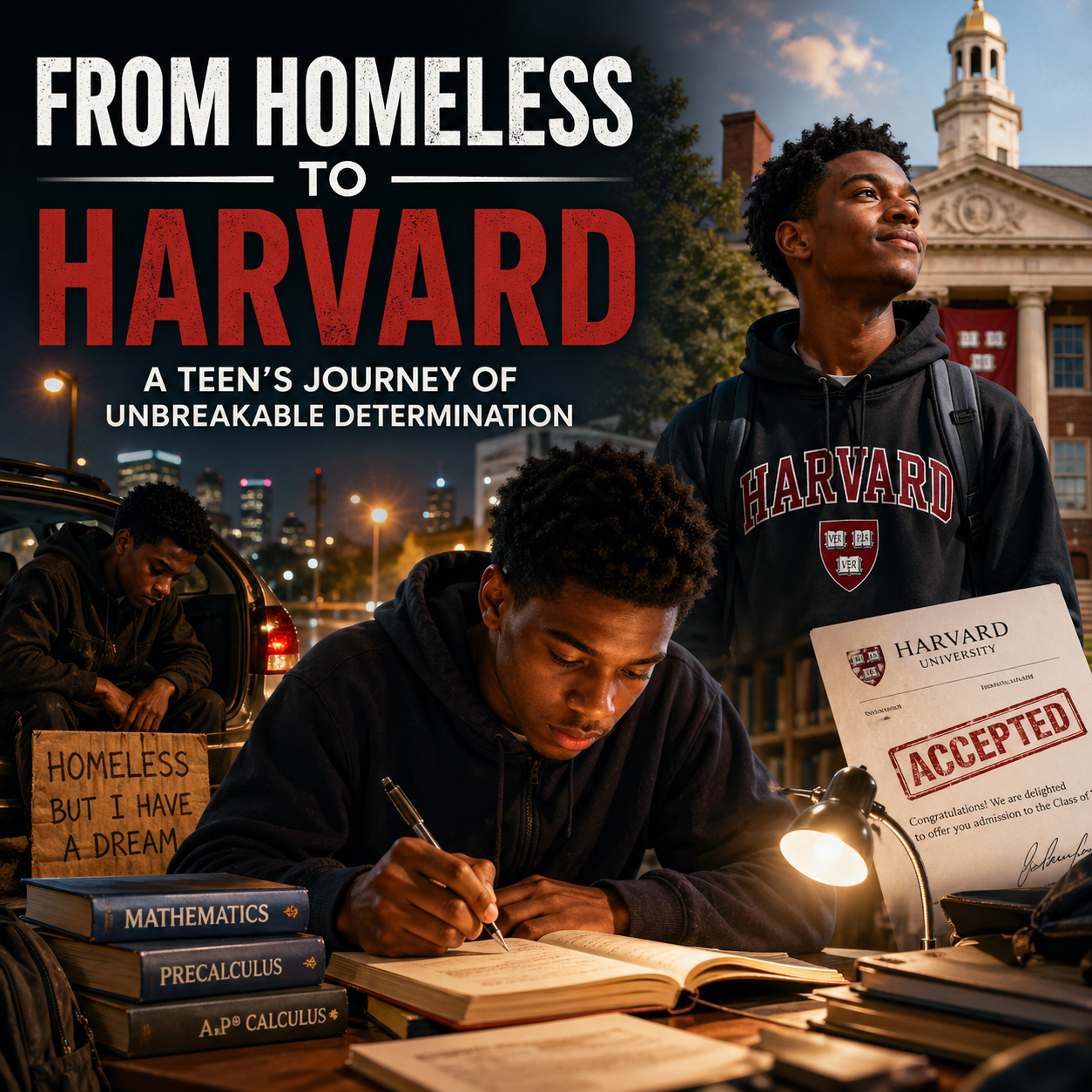
Part 1: Sleeping Under Streetlights
The first night Jason Carter slept in a car, he didn’t cry.
He stared out the fogged-up window at a flickering streetlight in a quiet parking lot somewhere in Oakland, California, his breath forming small clouds in the cold air. His mother was asleep in the front seat, her head tilted against the steering wheel, exhaustion pulling her into a restless silence. Jason sat in the back, hugging his backpack like it contained everything that mattered—because it did.
Inside were three notebooks, a worn algebra textbook, and a library card.
He was sixteen years old, and he was homeless.
Just two weeks earlier, life had been fragile but stable. They lived in a small apartment—nothing fancy, but it was theirs. His mom worked two jobs, cleaning offices at night and helping at a diner during the day. Jason spent most of his time at school or studying at the public library, dreaming quietly of something bigger.
Then came the eviction notice.
Rent had gone up. Hours at the diner had gone down. And one unexpected medical bill had tipped everything over the edge.
Jason remembered the day the landlord knocked on the door. His mom tried to stay calm, nodding as she listened, promising she would find a way. But that night, he heard her crying in the kitchen for the first time in years.
A week later, they packed everything they could fit into the car.
And just like that, home became a memory.
At school, Jason said nothing.
He showed up every morning, clean and composed, his clothes carefully rotated and washed in public restrooms or laundromats when they could afford it. He arrived early to use the school bathroom, brushing his teeth before anyone else came in.
No one noticed.
Or if they did, they didn’t ask.
Jason liked it that way.
What people did notice was his performance. He was one of the top students in his class—quiet, focused, and relentlessly driven. Teachers often described him as “disciplined” and “mature beyond his years.”
They didn’t know discipline was no longer a choice. It was survival.
Every afternoon, instead of going “home,” Jason walked to the public library. It became his sanctuary. Warm, quiet, predictable. A place where he could be just another student with big ambitions.
He stayed until closing time.
Then he walked back to wherever his mother had parked for the night.
Sometimes it was a supermarket parking lot. Sometimes a quiet residential street. Occasionally, if they had a few dollars, a cheap motel.
But most nights, it was the car.
One evening, while studying for a calculus test, Jason’s stomach growled loudly enough to echo in the silent library.
He hadn’t eaten since lunch.
He pressed his hand against his stomach and kept working.
Hunger, like everything else, had become something he could push aside.
That night, his mom handed him a small sandwich wrapped in a napkin.
“I got this from the diner,” she said softly. “They were going to throw it away.”
Jason smiled. “Thanks, Mom.”
He broke it in half and handed her a piece.
They ate in silence.
Weeks turned into months.
Winter came, bringing colder nights and longer struggles. Jason learned how to layer clothes, how to stay warm without blankets, how to sleep lightly.
But through it all, one thing never changed:
He kept studying.
He studied in the library, in the car, under streetlights when necessary. He reviewed notes while waiting in lines, memorized vocabulary words while walking, and solved equations in his head before falling asleep.
School became more than just a place—it became his path out.
One afternoon, his guidance counselor, Mrs. Alvarez, called him into her office.
“Jason,” she said, looking over his transcripts, “have you ever thought about applying to Ivy League schools?”
Jason blinked.
“I mean… Harvard, Yale, places like that?”
He hesitated. “That’s for… different kinds of students.”
Mrs. Alvarez leaned forward. “No, Jason. That’s for students like you.”
He didn’t say anything, but something shifted in that moment.
For the first time, Harvard didn’t feel like a distant dream.
It felt like a possibility.
That night, sitting in the backseat of the car, Jason opened his notebook and wrote one sentence at the top of a blank page:
“Get into Harvard.”
Then he underlined it.
Twice.
Part 2: Fighting the Odds
Applying to college is stressful for most students.
For Jason, it felt nearly impossible.
It wasn’t just about grades or essays. It was about everything else—the parts no one talks about. Stable internet. A quiet place to write. Application fees. Recommendation letters. Deadlines that don’t wait for life to settle down.
Jason had none of those advantages.
But he had something else:
Relentless determination.
Every day after school, he returned to the library, now not just to study—but to build his future.
He spent hours researching colleges, scholarships, and financial aid programs. He learned how to navigate application portals, how to write personal statements, how to tell his story without sounding like he was asking for pity.
Because he wasn’t.
He was proving something.
His personal essay took weeks to write.
At first, he didn’t want to talk about being homeless.
It felt too personal. Too exposing.
But Mrs. Alvarez encouraged him.
“Your story matters,” she said. “Not because it’s sad—but because it shows who you are.”
So Jason wrote.
He wrote about nights in the car. About studying under streetlights. About his mother’s sacrifices. About the quiet strength it took to keep going when everything felt uncertain.
But most importantly, he wrote about hope.
Not the kind that waits for things to get better.
The kind that works for it.
Meanwhile, life didn’t get easier.
His mom lost one of her jobs.
Money became tighter. Food scarcer. Stress heavier.
There were nights when Jason couldn’t focus, when exhaustion blurred the words on the page, when doubt crept in like a shadow.
“Maybe this is too much,” he thought.
“Maybe I should just get a job and help out.”
One night, he almost closed his laptop for good.
But then he looked at his notebook.
At the words he had written months ago:
Get into Harvard.
And he kept going.
Support came from unexpected places.
A teacher waived fees for exam prep materials. A librarian quietly extended computer time limits for him. Mrs. Alvarez helped cover application fees through school programs.
No one made a big deal about it.
They just helped.
And Jason never forgot.
The day he submitted his Harvard application, he sat in silence for a long time.
It felt surreal.
Like sending a message into the universe and hoping it would answer.
Then came the waiting.
Weeks passed.
Life continued—still uncertain, still difficult.
Jason tried not to think about it, but it was always there, in the back of his mind.
What if he didn’t get in?
What if all of this wasn’t enough?
One afternoon, while sitting in the library, he refreshed his email.
And there it was.
“Your application status has been updated.”
His heart started racing.
His hands trembled slightly as he clicked the link.
For a moment, the screen just loaded.
Then—
A letter appeared.
He read the first line.
Then the second.
Then he stopped.
His eyes filled with tears.
He couldn’t breathe.
He read it again, just to be sure.
He had been accepted.
To Harvard.
Part 3: A New Beginning
Jason didn’t shout.
He didn’t jump.
He just sat there, staring at the screen, tears quietly streaming down his face.
For a moment, the world felt still.
Then everything hit at once.
Every sleepless night. Every skipped meal. Every moment of doubt.
It had all led here.
He ran out of the library and down the street, his phone in hand.
His mom was parked a few blocks away.
When he reached the car, he opened the door, breathless.
“Mom,” he said, his voice shaking. “I got in.”
She looked at him, confused. “Got in where?”
He smiled, tears in his eyes.
“Harvard.”
For a second, she didn’t react.
Then her face changed.
And she started crying.
They hugged in the front seat of that old car, holding onto each other like they had through everything else.
But this time, it was different.
This time, it was joy.
News of Jason’s acceptance spread quickly.
Teachers celebrated him. Classmates who barely knew him suddenly saw him in a new light. Local organizations reached out, offering support, scholarships, and even housing assistance.
For the first time in a long time, things started to feel… stable.
Graduation day came.
Jason walked across the stage, his name echoing through the auditorium.
When he received his diploma, he looked out into the crowd.
His mom was there, clapping harder than anyone else.
Months later, Jason stood on Harvard’s campus.
The buildings were grand. The air felt different. The future felt wide open.
But he didn’t feel out of place.
He felt ready.
He still carried the same backpack.
Inside it were new books, new goals, new dreams.
But also something else:
The memory of where he started.
Jason didn’t forget the car.
Or the streetlights.
Or the library that became his refuge.
Because those weren’t just struggles.
They were the foundation of who he became.
Years later, Jason would return to communities like the one he came from.
He would speak to students facing the same challenges, telling them something simple but powerful:
“Your circumstances don’t define your future. Your decisions do.”
And every time he said it, he meant it.
Because he had lived it.